An improperly selected fan can limit the unit’s performance, compromise cooling uniformity, or lead to problems that only become apparent during daily operation. Therefore, the selection process should not be limited solely to diameter, supply voltage, or price. It is becoming increasingly important to be able to choose from various configurations of fans, motors, and impellers, allowing the component to be tailored to a specific application rather than simply selecting the closest replacement. The support of experienced engineers and technical advisors–such as those at AiFO Components–is also crucial, as they can assist with any issue related to the proper selection of a fan for a given application.
In this article, we explain why airflow is so important in refrigeration, what types of fans are used in refrigeration equipment, and how they differ in terms of design, drive, bearings, and operation. We also show what to look for when selecting a fan that is suited to the actual operating conditions of the unit, rather than relying solely on catalog specifications.
Why is forced air flow essential in refrigeration?
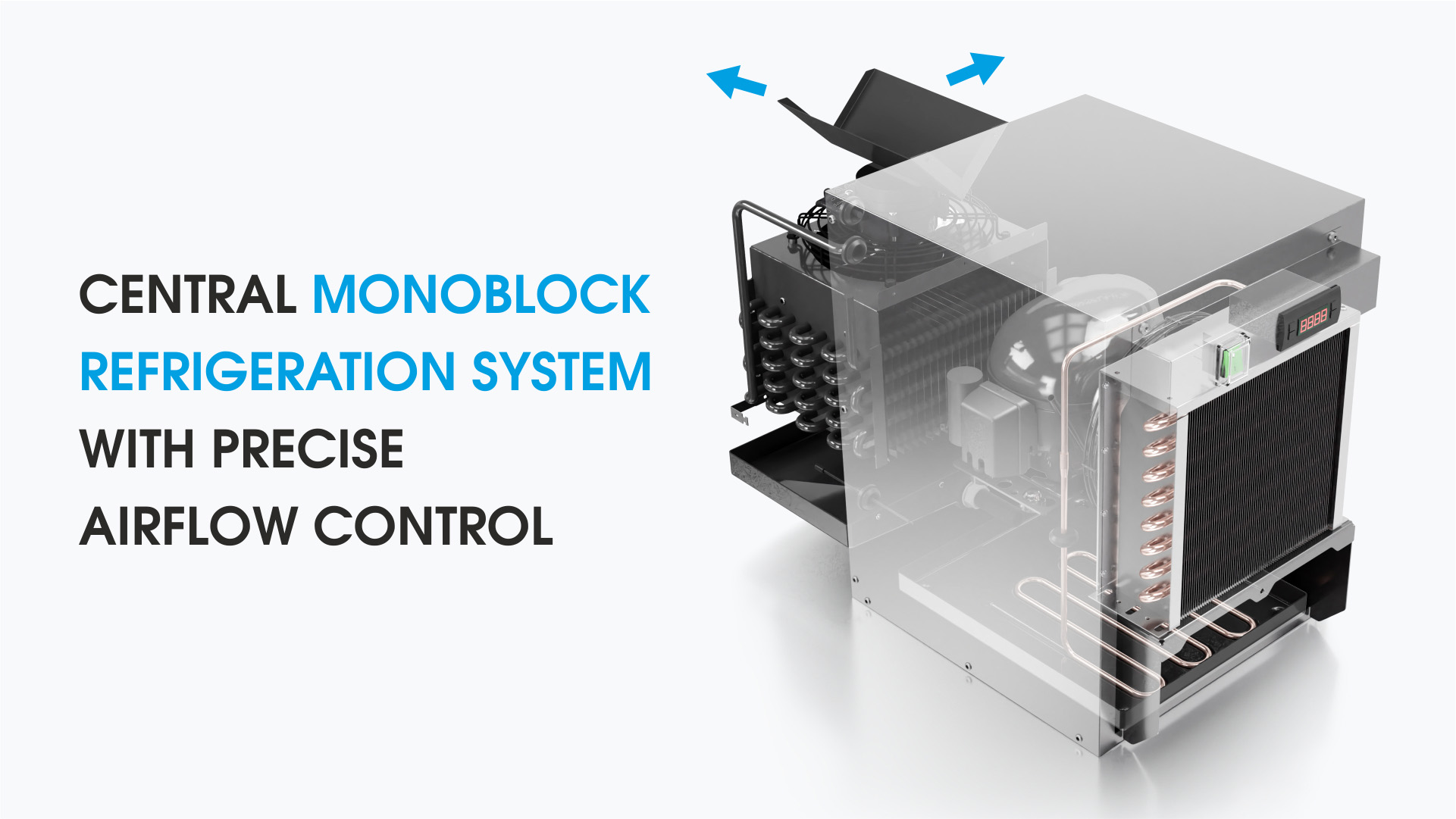
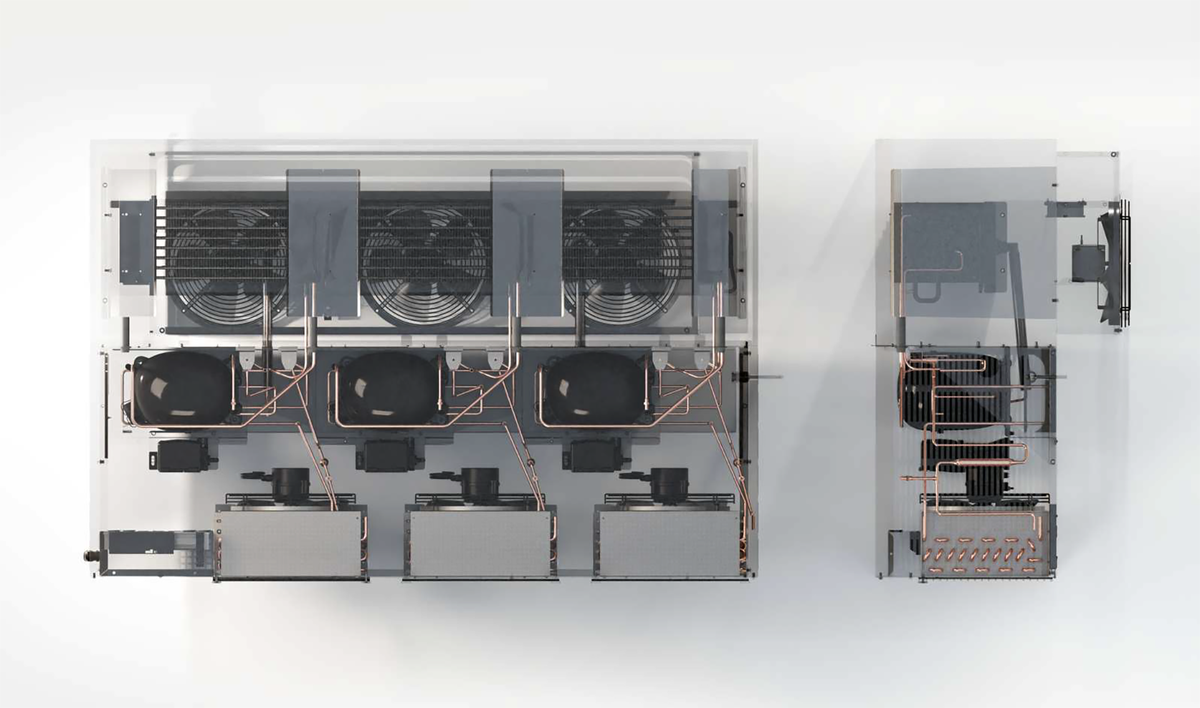
The principle of operation of a refrigeration unit is based on the controlled removal of heat from the space being cooled and its transfer outside that space. Whether we’re talking about a walk-in cooler, a counter, a display case, a refrigerated table, or a commercial kitchen appliance, the entire process boils down to transferring thermal energy from the interior of the unit to the evaporator, and then from the condenser to the surrounding environment.
Heat transfer plays a key role in both of these stages. It can occur through conduction, radiation, and convection; however, in refrigeration systems, forced convection–that is, air movement caused by a fan–is of particular importance. It is forced convection that increases the contact between the air stream and the heat exchanger surface, allowing for more efficient heat removal on the evaporator side and more effective heat transfer on the condenser side.
In practice, it is not only the presence of airflow that matters, but also its intensity, direction, and uniformity. Air should reach the areas where heat exchange occurs, while at the same time it must not bypass parts of the cooled space or create zones with limited circulation. This is particularly important in systems where products are arranged on multiple levels, obstruct part of the airflow, or alter operating conditions depending on the load level.
Insufficient air circulation in the refrigerated space leads to localized temperature increases and uneven cooling of products, while insufficient flow through the condenser impairs heat transfer to the environment. Conversely, airflow that is too intense or poorly directed causes unnecessary noise, dries out the products, and increases energy consumption.
Types of Fans Used in Refrigeration
In refrigeration, axial and cross-flow fans are the most common, while larger systems also utilize industrial solutions such as axial turbines. Compact fans deserve special mention–not as a separate type of airflow, but as a practical design for a complete fan assembly.
Axial fans
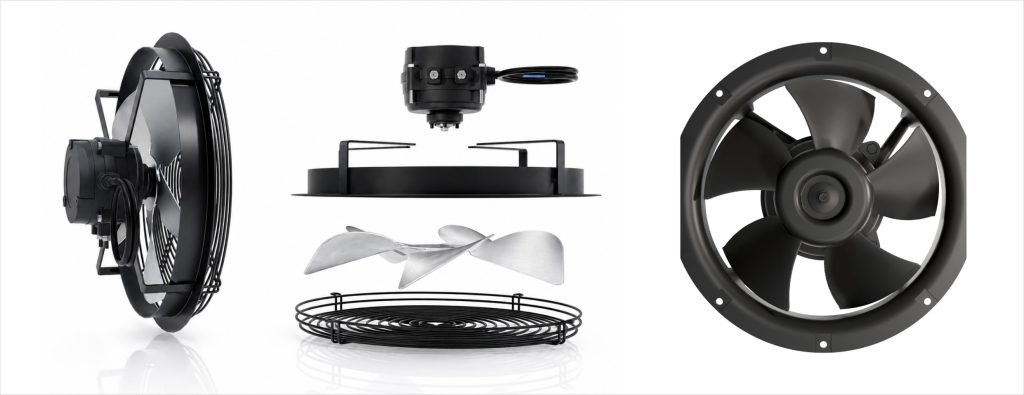
Axial fans are among the most popular solutions used in refrigeration equipment. Air generally flows through them along the axis of the impeller’s rotation. This design works well where a relatively high airflow is needed with moderate resistance–which is why axial fans are most commonly used in evaporators and condensers.
Their advantages include a simple design, wide availability, and a broad range of options in terms of diameter, power, rotational speed, and power source. Axial fans are well-suited for applications where air needs to be forced through a heat exchanger or directed in a specific direction without a complex ductwork system. In retrofit projects, the availability of both complete assemblies and individual components is crucial, as it facilitates maintenance and reduces equipment downtime–such components can be purchased from reputable European suppliers, such as AiFO Components.
Compact Fans
Compact fans are integrated units in which the motor, impeller, housing, mounting frame, or shroud form a complete module. Their advantages include easier installation in confined spaces, repeatable assembly, and a lower risk of incorrect assembly of individual components. Such solutions work well in devices where quick installation, serviceability, and predictable operating characteristics are essential.
Cross-flow fans
The second important group consists of cross-flow fans. Their design is based on an elongated impeller, which allows for a wide and relatively uniform airflow while maintaining a compact form factor. As a result, they perform well in refrigerated counters, display cases, and tables, where designers must balance effective air circulation with limited space for components.
In such applications, the goal is not always to achieve the highest possible airflow at a single point. It is often more important that the fan can be conveniently integrated into the device’s design and that stable air circulation can be achieved without a complex duct system. Thanks to its geometry, a cross-flow fan facilitates the flow of air along a longer working zone–which is particularly beneficial where the product is displayed over a larger area or where it is important to minimize local temperature differences.
Axial Turbines in Industrial Refrigeration
Axial turbines are commonly found in larger refrigeration systems, especially industrial ones. These solutions are designed for higher flow rates, different pressure ranges, and operation under more demanding conditions. They effectively move large volumes of air through heat exchangers, ducts, or complex flow systems while maintaining a controlled flow direction. They are ideal for applications where high efficiency, mechanical durability, and stable operation under increased loads are critical.
The choice of fan type should be based on the function it is intended to perform in a specific system. A condenser that dissipates heat to the environment requires a different solution than an evaporator in a refrigeration chamber, which in turn requires a different solution than a system with higher flow resistance, and yet another for a refrigerated display case, where uniform air circulation and convenient installation in a confined space are key. In every case, it is important to consider the fan in the context of the entire application, rather than simply as a replacement with similar dimensions.
Construction of a refrigeration fan–what does the unit consist of?
The differences between fan types are not solely due to the way the airflow is directed. The design of individual components and how they interact within a specific unit are also of great importance. Regardless of the type, a cooling fan is an assembly of several parts responsible for generating, directing, and maintaining airflow.
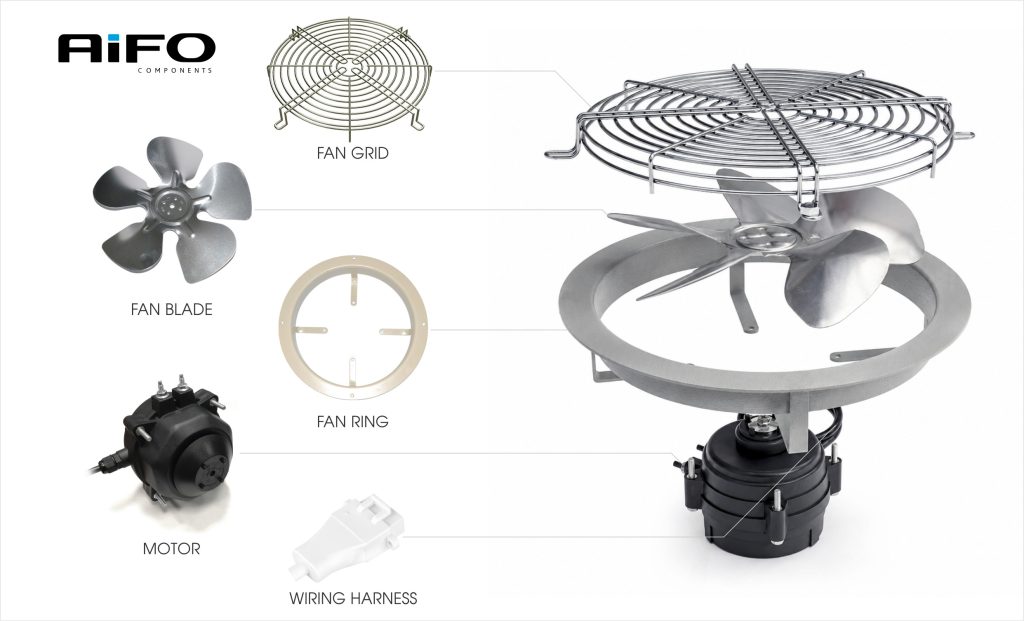
Engine
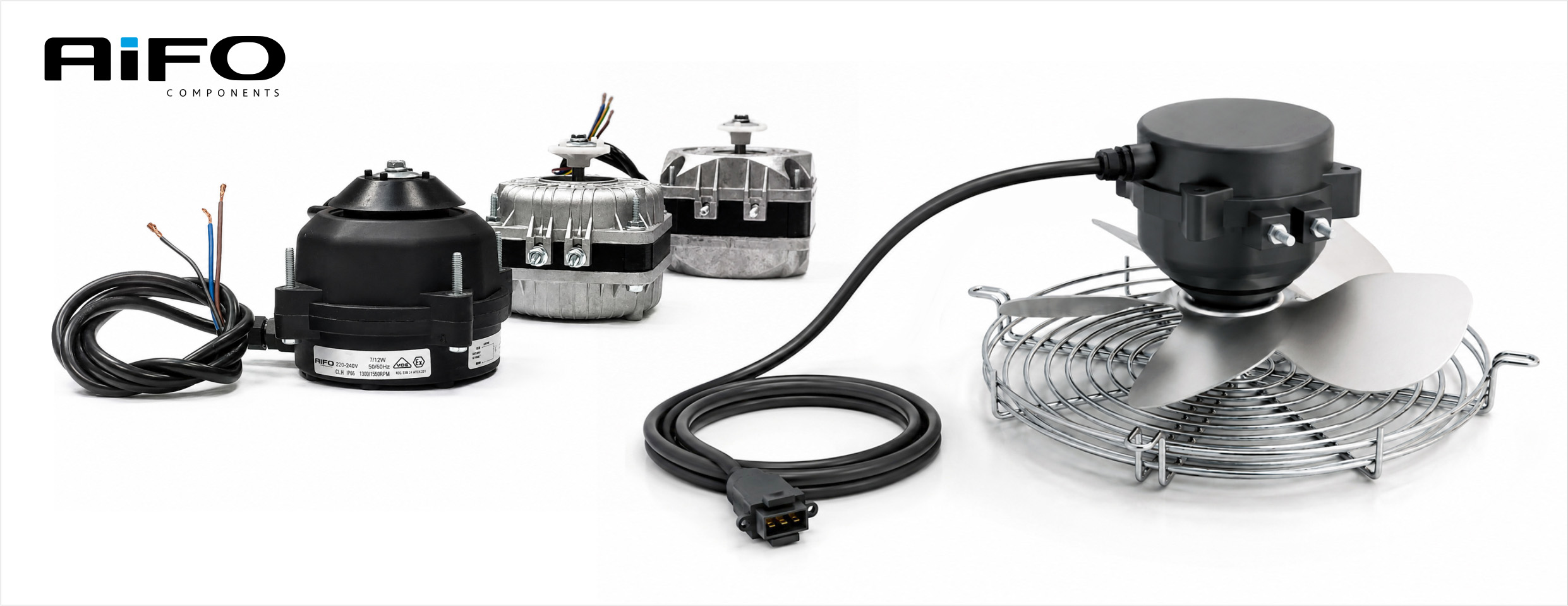
The core component is the motor, which generates torque and drives the rotor. Its design determines the power consumption, rotational speed, adjustability, control method, and energy efficiency of the entire unit. In practice, both classic AC motors, powered by alternating current, and more modern EC motors, which are electronically controlled, are commonly used.
Rotor and propeller
The rotor’s design determines how air is set in motion. In axial fans, it most often takes the form of a propeller; in cross-flow fans, it takes the form of an elongated cylinder with appropriately shaped blades. For propellers, the most important factors are the diameter, the number of blades, their profile, the angle of attack, the material, and the direction of operation. These parameters simultaneously affect airflow capacity, power consumption, noise level, and motor load–which is why changing just the propeller while keeping the same drive can significantly alter the behavior of the entire unit. For this reason, it is advisable to take advantage of an offering that includes various propeller and motor options, available from the supplier’s own inventory, as is the case with AiFO Components.
Flow direction: suction or discharge fan?
What matters is not only how much air the fan moves, but also the direction of the airflow. Depending on the impeller design, direction of rotation, and installation configuration, the fan can operate in either a suction or discharge mode–drawing air through the heat exchanger or forcing it toward it. Both options can be correct, provided they are consistent with the unit’s design and the geometry of the flow system. Incorrect selection of the direction can limit heat transfer efficiency even when the diameter, voltage, and power appear to meet the application’s requirements.
Covers, Frames, and Protective Grilles
Guiding and protective components–guards, frames, rings, and grilles–protect the user and the fan from mechanical damage, but they also affect how the air flows. In a well-designed unit, the guard is not a random accessory but an integral part of the airflow system. Its shape, distance from the impeller, and method of installation can improve the fan’s operational characteristics or, conversely, increase resistance and noise.
Bearing Arrangement and Operating Position
Bearings ensure the stable and reliable operation of rotating parts. The type of bearings affects the fan’s service life, permissible operating position, load capacity, temperature range, and the component’s performance during long-term operation. The fan can be mounted horizontally, vertically, or at an angle; however, not every design is equally well-suited for all mounting positions. This is particularly important in refrigeration systems, as components operate at low temperatures, under varying humidity levels, subject to vibrations, near heat exchangers, and sometimes under conditions of periodic icing. Experienced technical and sales consultants, such as those at AiFO Components, take these parameters into account as early as the selection stage–an incorrectly selected version can shorten the service life of even a properly selected motor.
Two models with similar dimensions may differ in noise level, durability, flow characteristics, and the ability to overcome resistance in a specific installation. Therefore, it is advisable to analyze a fan as a system of interacting components rather than as a single part with a specific diameter and voltage.
Key Parameters for Selecting a Cooling Fan
When selecting a fan, it is important to consider not only its electrical specifications but also the parameters that describe its behavior in a flow system:
- Capacity –airflow rate, most commonly expressed in m³/h. It indicates how much air a fan can move under specific conditions, but this alone is not sufficient to assess whether the fan has been properly selected.
- Static pressure –the ability to overcome flow resistance. In a real-world system, air encounters resistance from heat exchangers, dampers, grilles, ducts, filters, and constrictions. A fan with high rated capacity but insufficient static pressure may not deliver the expected airflow once installed.
- Other parameters –rotational speed, power consumption, sound pressure level, IP rating, operating temperature range, insulation class, and control method.
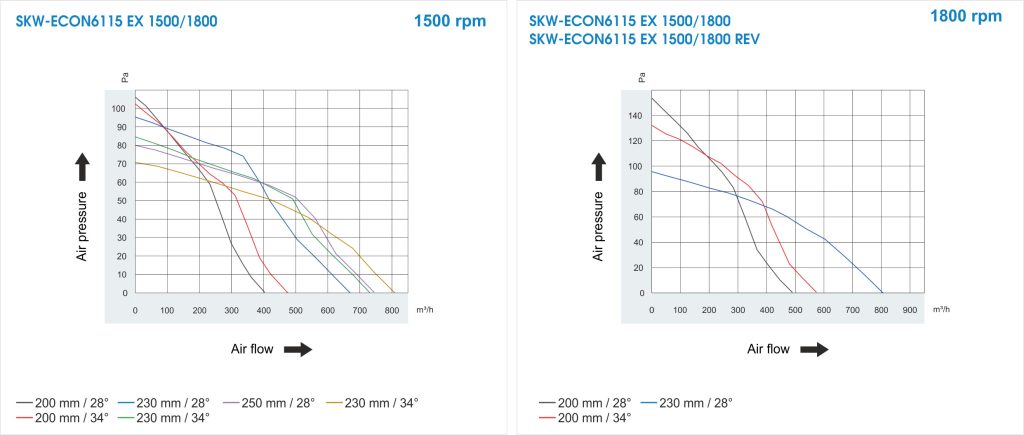
As flow resistance increases, the fan’s operating point changes, and the resulting airflow may differ significantly from the value specified for free flow. From a design perspective, this means that a fan must be selected for a specific installation, rather than based solely on catalog specifications. That is why it is advisable to choose a supplier with a broad portfolio of options–this allows you to select a solution that fits the system, rather than adapting the system to the available component.
AC or EC Motor–Which Fan Drive Should You Choose?
One of the most important selection criteria is the type of drive. At first glance, AC and EC motors perform the same function–they drive the impeller and force air to flow. The differences lie in their operating principles, energy efficiency, control capabilities, and performance during long-term operation.
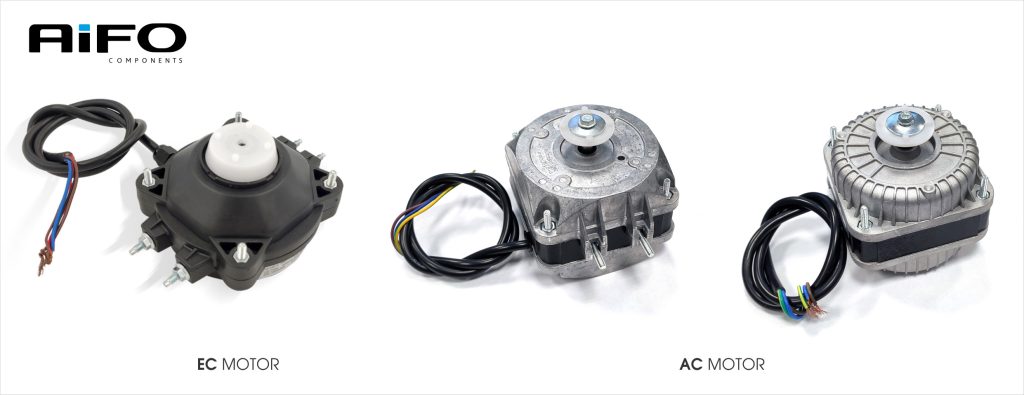
Fans with AC Motors
AC (alternating current) motors are a classic solution that has been used in refrigeration for years. Their advantages include simple design, wide availability, and affordable price. In standard applications where the equipment does not require advanced speed control, an AC fan may still be entirely sufficient–particularly in simpler systems with constant operating conditions and where ease of maintenance and cost-effective component replacement are priorities.
However, simplicity comes with limitations: speed control is less flexible, and energy efficiency during continuous operation may be lower. In typical systems, an AC fan operates at a single base speed, so the influence on performance is limited mainly to the selection of the impeller diameter, the number of blades, and the angle of attack. In devices that operate for many hours a day, the difference in energy consumption becomes significant not only for operating costs but also for the operating temperature of components and the device’s quietness.
Fans with EC motors
EC (electronically commutated) motors combine the design of a brushless motor with control electronics. As a result, EC fans achieve higher efficiency, operate more quietly, and better adjust their rotational speed to the device’s current demand–which is particularly important in modern systems where reducing energy consumption and ensuring stable operation under variable conditions are key.
An advantage of the EC drive is greater control flexibility: the speed can be adjusted in discrete steps (fixed speeds) or continuously, e.g., via a PWM signal or a 0–10 V signal. The fan can respond to a signal from the controller or adjust its operation to the conditions inside the device. This helps prevent situations where the fan runs at full capacity when it is not needed–reducing energy consumption, noise, and stress on components. Selected versions also allow for changing the direction of rotation, which provides additional application flexibility (always check the documentation for the specific model).
However, an EC fan is not always the only appropriate choice. It is more expensive, more complex, and requires proper electrical sizing as well as protection of the electronics against temperature, humidity, dust, and power quality issues. In simpler applications, an AC fan remains a technically and economically sound solution.
Operating Costs–The Real Difference Between AC and EC
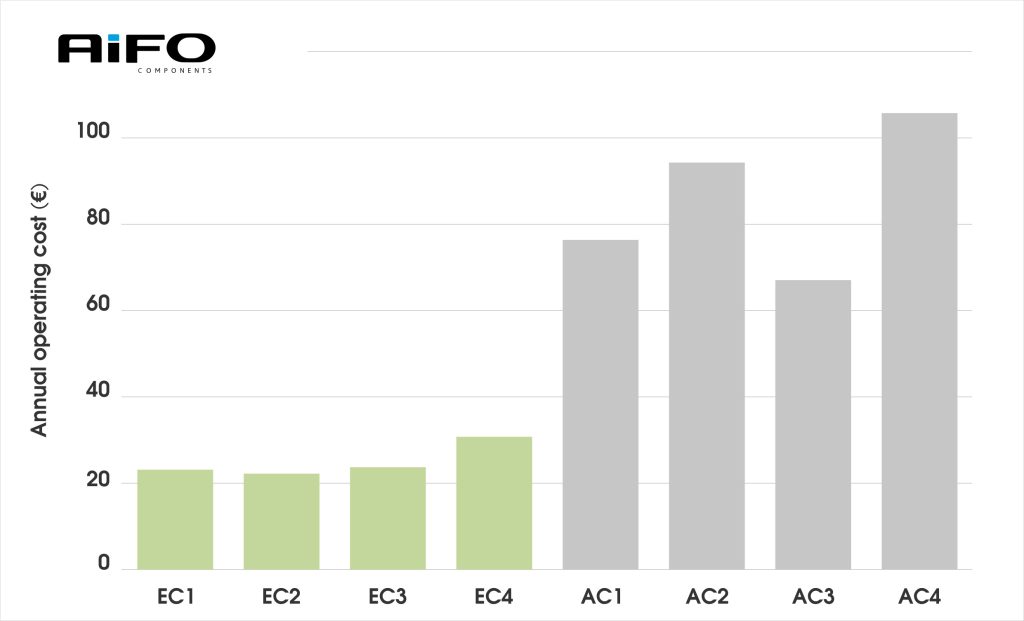
In refrigeration systems, fans often operate continuously for many hours a day; therefore, differences in efficiency and control affect the total cost of ownership of the equipment, not just the price of the component. A comparison of the annual cost of continuous operation of eight motors driving the same fan blade shows that the choice of drive system is significant not only from a technical standpoint but also from an economic one. Access to the performance characteristics of fan assemblies–such as the AiFO Components catalog, which provides all the data necessary for proper selection in one place–is helpful for such a comparison.
If simplicity, low purchase cost, and easy availability of replacement parts are the top priorities, an AC fan will often suffice. If the device is expected to operate for a long time, quietly, energy-efficiently, and under varying load conditions, it’s worth considering an EC fan.
Summary
A fan in a refrigeration unit is more than just a component responsible for air circulation. It is a part of the system that affects how heat is absorbed and dissipated, and thus the operational stability of the entire unit. Its selection should be based on the conditions of the specific application: the type of heat exchanger, installation geometry, expected airflow, air resistance, permissible noise levels, control method, and expected operating time.
It is equally important to view a fan as a system of interdependent components: the motor, impeller, housing, mounting method, and bearings all work together to determine how the component performs under actual operating conditions. Therefore, a fan that looks similar to another model will not always be a suitable replacement for it.
The choice between AC and EC motors should not be viewed as a simple “better vs. worse” comparison. AC motors continue to perform well in standard applications, while EC solutions excel where energy efficiency, speed control, lower noise, and long-term operation are key. If in doubt, it’s worth consulting an experienced technical and sales advisor at AiFO Components about your application requirements; they will help you compare the available options and choose the solution that best meets the needs of your equipment.
A properly selected fan ensures predictable, stable, and efficient operation of the cooling system. A poorly selected fan becomes a source of problems that are not apparent at the time of purchase but, in practice, affect the unit’s performance, energy consumption, and reliability. Therefore, selecting a fan should be treated as a design decision rather than simply choosing a single part from a catalog.