Heating cable with thermostat
Heating cables with a thermostat are used as frost protection – to protect pipes, pipelines and valves. A heating cable can be installed in several ways. One of the simplest is to fix it to the surface of the pipe, either by wrapping the cable around it or by running it along the whole length of the pipe using adhesive, clips or brackets. Heating cables can be supplied with a sealed plug.
It's worth protecting the plumbing system against low temperatures, because frozen water can block the flow and even damage the pipe or connection. Cold winter temperatures can be dangerous to pipes and valves. Bringing to an emergency, where there is a break in the supply of water or other medium, is costly and uncomfortable for the residents. Interruptions in the supply of heating or water and the possibility of its re-availability only after several hours, is often dangerous due to the lack of heating, very low temperatures or loss of the machine cooling system.
The heating cable with a thermostat also allows to protect other surfaces, such as gutters, floors, stairs, frames or walls.
A heating cable with a thermostat is the right product for customers looking for a solution in which the cable – or strictly speaking the thermostat itself – controls the set temperature. The product is complete: there is no need to buy a separate thermostat or to install one. The thermostat sits at the coldest point of the cable.
A heating cable with a built-in thermostat will satisfy even the most demanding users.
Self-regulating heating cable
Self-regulating heating cables we offer are excellent products in terms of quality, energy efficiency and ecology. The ambient temperature closely affects the heating power of the product. The heating cable works with great power at low temperatures. As the temperature rises, the power decreases.
Heating cable – application
The heating cable has many different applications. It's used for:
Underfloor heating
The heating cable is installed in the substrate. The floor finish of the customer's choice – tiles, panels and so on – is laid on top. The power supply is then connected to the installation. For both the cable and the mat we recommend adding an underfloor heating controller (GK-CNTR1001) and a panel for the underfloor heating controller (GK-CNTR1000). The set makes it easy to control the temperature and is simple to operate.
Ground frost protection
The heating cable is installed between the cooling chamber and the ground. This protects ground against freezing, which also protects floor in the cold store and its entire structure.
Pipe protection
The heating cable is used to protect pipes and valves against freezing. It works even on large installations. A large pipeline, standard-diameter pipes, small tubes – besides their own insulation, such as polyethylene foam, all of them need additional protection when exposed to sub-zero temperatures. A heating cable performs this task very well, protecting water pipes.
Heating cable can be inside the pipe or outside. Then the easiest way to get a good place is to wrap the wire around pipe.
Protection of gutters and roofs
Heating cable is also used to protect gutters and roofs against ice and snow. Mounting the heating cable on the gutter is an easy way to get rid of sagging icicles and unblock the flow. In this way, we increase the safety of people and things next to the building.
Heating driveways
Heating cable is also used on driveways in front of garages, buildings and other facilities. Used this way, it protects a section of road against freezing while clearing it of snow and ice. That relieves us – or our staff – of clearing snow from the approach to the property or from a stretch of road.
Elimination of thermal bridges
Heating cables are used for more than pipe protection and underfloor heating. They also serve to eliminate condensation on thermal bridges in buildings and in various appliances. For thermal bridges inside rooms, a cable with a thermostat is installed under the plaster. It stays invisible and does not spoil the look of the room. By warming the structure we remove moisture and prevent mould from developing in corners, behind furniture and in other vulnerable places.
The use of heating cables in devices, in order to eliminate thermal bridges is closely related to the use of various types of profiles. Our offer includes many systems designed to eliminate thermal bridges that are compatible with heating cables. An example of a product is PU-227 profile or PU-226 profile.
Heating cable length
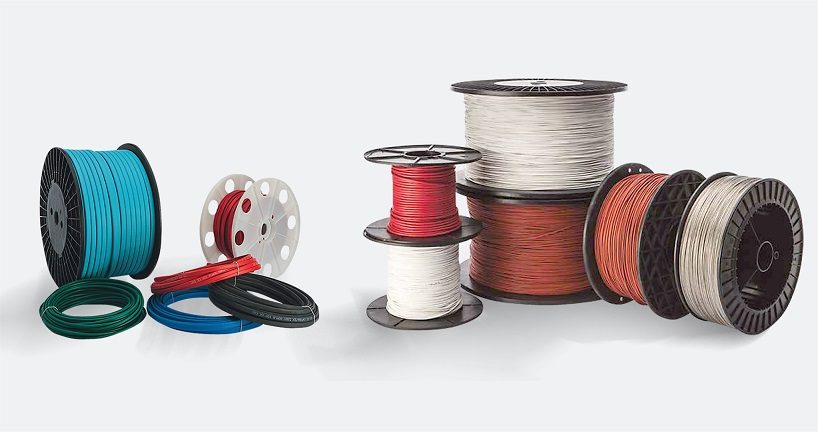
The length of a heating cable is closely tied to where it will be used. An advantage of many silicone cable models is the choice of a cable spool of a specific length (100, 250, 400 or 500 m) or cutting the heating cable to a given length in line with the guidelines. For antifreeze heating cables with a thermostat, shorter lengths are available (for example 1 m + 1 m, 2 m + 1 m, 4 m + 1 m).
Wires in the spool have contact points every 500 mm, so they may only be cut in these points. Cutting cable in the wrong place will damage it.
Length of the power cord and the working length, i.e. cold and heating part, may differ from model to model. However, it's possible to specify length of the power cord.
An example of an antifreeze heating cable with thermostat a 2 m + 1 m has a 2 m heating section and a 1 m cold section.
Insulation thickness
Heating cables with and without a built-in thermostat, differ from each other in cable diameter and insulation thickness. Thicker insulation allows the cable to be used outside of livestock, industrial and gastronomic buildings.
Contact with our advisors
Our experts will gladly answer any question about heating cables. We also encourage you to use our new online shop, which offers fast and secure purchasing. Ordered products are packed without delay and delivery is express.
Stay up to date
We encourage you to subscribe to the newsletter. Thanks to it, everyone can be up to date with new products. Newsletter is a weekly one-off sending of information about a new product and other interesting solutions.